 2 Pieces of the American Revolution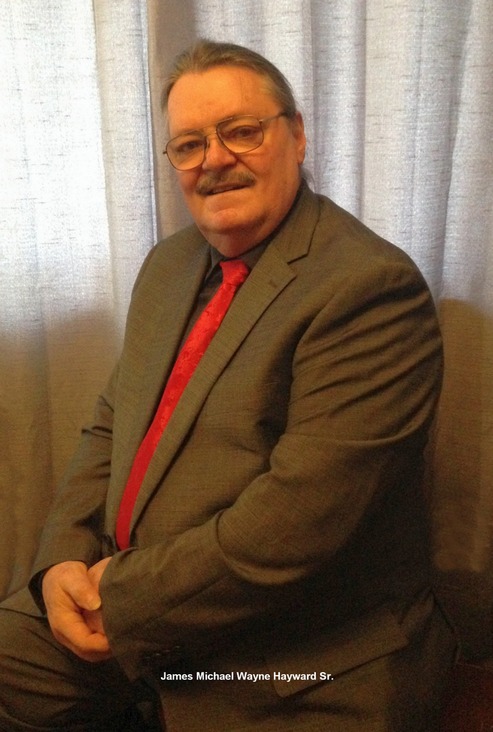
By James M W Hayward Sr. (April 19, 2017)
2 Pieces of the American Revolution
By James M W Hayward Sr. (April 19, 2017)
What is it said about New Englanders and their rocks? We like our rocks in New England and many rocks were named and given some special importance, such as Plymouth Rock. Maybe because in Europe they have their megaliths, ancient objects of mysticism and reverence. Since America is lacking such ancient history, we simply have our rocks. Stones both large and small that have been imbued with special historical significance … whether apocryphal or not.
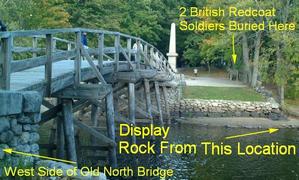
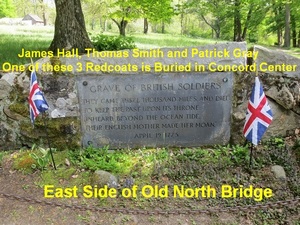
Not only in a Historical sense, but on a Personal note I have Aquired 2 Rocks (Displayed in Pictures Below) that are from 2 different Massachusetts locations, described in this document ... North Bridge in Concord and the Fiske Farm House in Lexington. These were there during Important Events that my Hayward Ancestors Fought and Died that Started the American Revolution.
Concord-Lexington Fight April 19, 1775
Early morning, 25 year old School Teacher James Hayward (b: April 4, 1750) traveled from his father’s home in West Acton, Massachusetts to the home of Captain Isaac Davis, Commander of the town’s Minute Company and then on to the Concord North Bridge to gather with other Colonial Militia. About the same time, 13 miles away in Lexington Common, now known as Lexington Battle Green, the British Regulars from Boston arrived to confront the Provincial Militia there of which later eight Colonial Militia were killed and ten wounded.
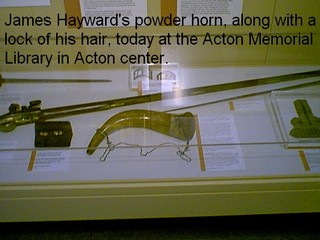
NOTE: James Hayward was exempt from service in the Acton Militia having one foot maimed in an accident with an axe in his youth. However, Hayward not only served in the Militia as a member of Lieutenant Hunt's Company, but he was also selected for the more elite service of 'Minute Men'. Not being a member of the Davis Company he had not been issued the gear that Captain Davis, a gunsmith, had gone to great effort to manufacture, apparently intent on equipping his men as well as British Regulars. Davis had issued a bayonet and cartridge box (the latter allowing more rapid fire) to nearly every man in the Minute Company. Rather than a cartridge box with pre-rolled cartridges of powder and ball, Hayward carried with him that morning swung at the hip, a hunting powder horn filled with loose gunpowder, that would later become such a powerful symbol.
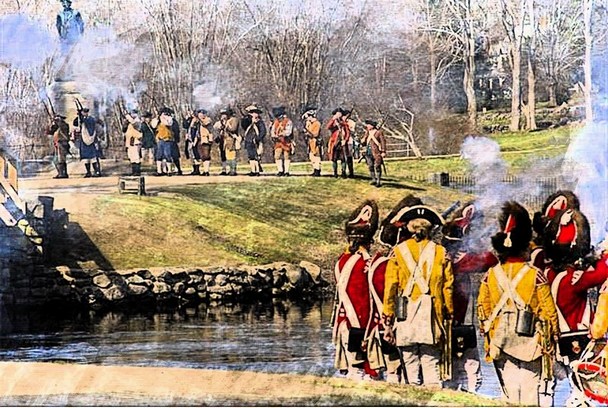
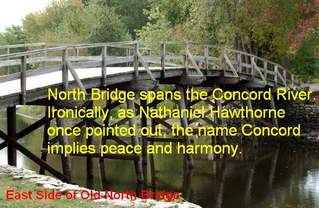
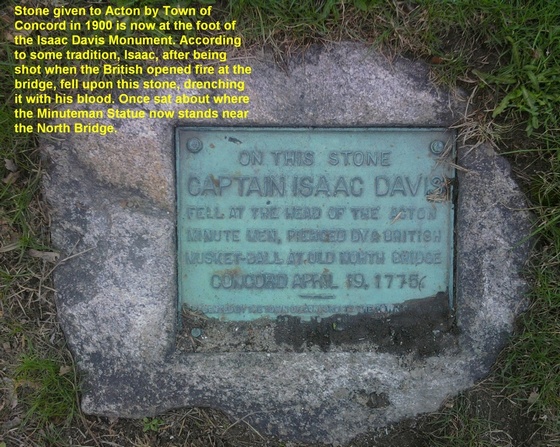
At the North Bridge, after much deliberation, the Provincial Militia and Minute Companies advanced on the small force of British Regulars holding the bridge. The Acton Minutemen led the column killing Three British Redcoats and wounding several others. Capt. Isaac Davis was killed in the first volley from the Regulars along with one of his men Abner Hosmer. Command was then passed to Lieutenant John Hayward (1740-1825, 2nd Cousin).
The incident at the North Bridge later was memorialized by Ralph Waldo Emerson in his 1837 poem “Concord Hymn,” whose opening stanza is: “By the rude bridge that arched the flood/Their flag to April’s breeze unfurled/Here once the embattled farmers stood/And fired the shot heard round the world.”
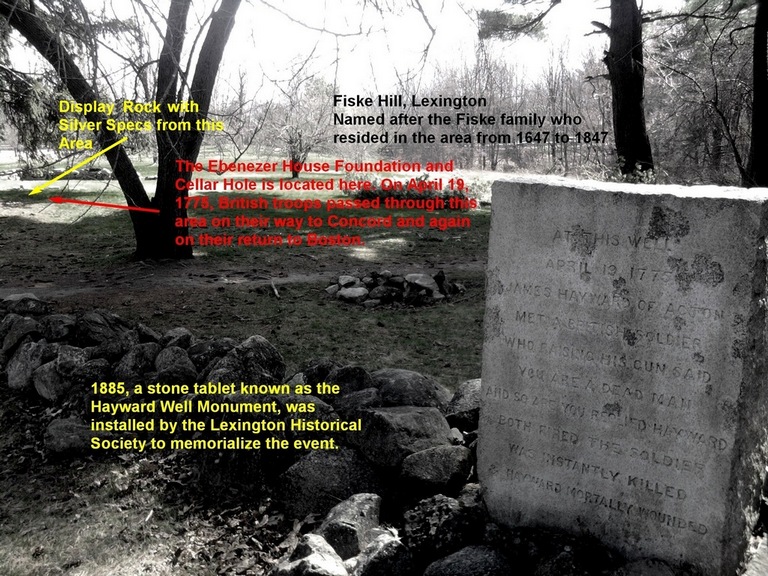
The British Troops started their retreat back to Boston, which ran through Concord, Lincoln, Lexington and Arlington on what we now call 'Battle Road'. All new to Military tactics most of the men joined Provincial Militia in the pursuit of the Regulars, presumably acting more or less on their own. By mid-afternoon, Hayward had pursued the British column along with his Compatriots for a long way, another 6 miles to Fiske Hill in Lexington. At Fiske's Hill in Lexington, they had, as some thought, the severest encounter of all along the way. Later in the day some Haywards not at the Bridge earlier heard about the event and caught up from other local areas to join with the Militia to fight. James younger brother Benjamin (b: Dec 1, 1752 d: Oct 20, 1836) and older brother Paul, my direct line, (b: April 2, 1745 d: Sept 6, 1842).
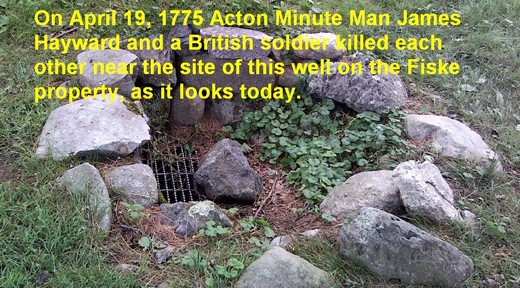
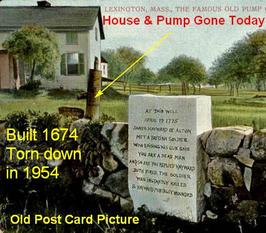
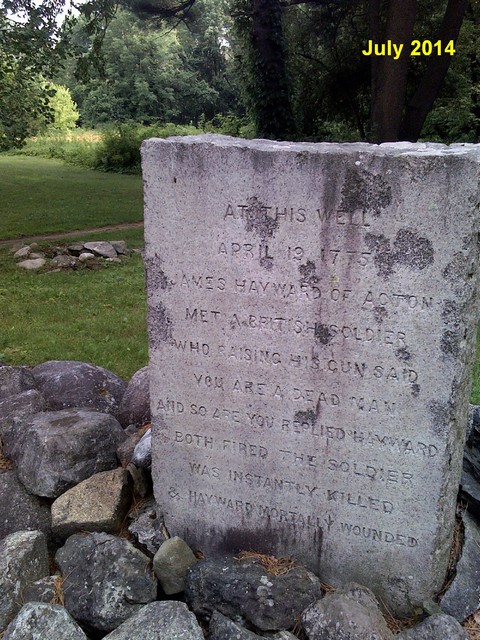
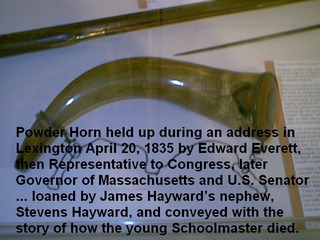
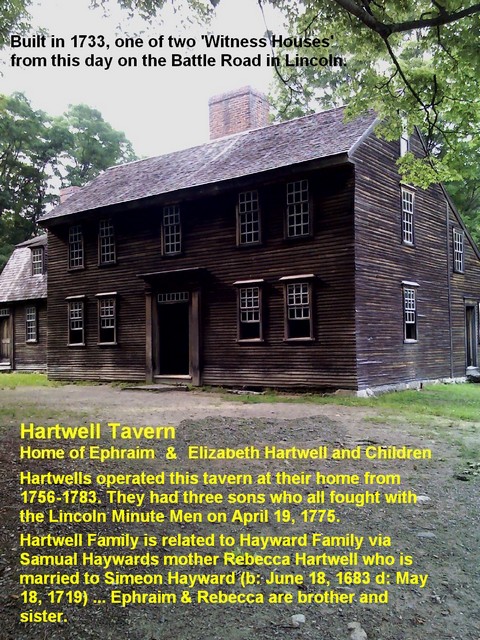
The area between Lexington and Concord was a war zone. Homeowners along Battle Road fled taking their families and valuables, leaving empty homes behind. But they were still being used by Minute Men for shelter for skirmishing. The road ran around the Eastern base of a steep, thickly-wooded hill. Hayward reached the Ebenezer Fiske House at the peak of the hill after the British column had passed through; he found it quiet and abandoned. Being active and foremost all the way he came down from the hill and was aiming for a Well Water Pump. As he passed by the end of that house he spied a British Soldier through a window, still lingering behind the main body of Redcoats, plundering. The Redcoat also saw Hayward and ran to the front door to cut him off. Lifting up his loaded musket he exclaimed, 'You are a Dead Man.' Hayward immediately said, 'So are you.' They both fired and both fell. The Briton was shot dead through the cheek. Hayward mortally wounded, the ball entering his side first passing through his Powder Horn, driving the splinters into his body and survived another eight painful hours. He was eventually discovered and his father, Deacon Samuel Hayward (b: Apr 5, 1713 d: Mar 6, 1791 ... also a Captain in Militia), was soon at his side. His father told James that he was mortally wounded and asked him if he was sorry he turned out.
NOTE: Story about James Hayward's Death is passed on from Rev. James Trask Woodbury (1803-1861) as he, allegedly, heard it from James Hayward’s now elderly brother Deacon Benjamin (b: Dec 1, 1752 d: Oct 20, 1836) and nephew Stevens Hayward, both of whom, it seems, he was quite close to. It could be that Deacon Samuel Hayward, upon finding his son was told the circumstances of his mortal wound by James himself and then Deacon passed those details, along with the gist of James’s words, to his family.
According to Woodbury, James responded, “Father, hand me my powder horn and bullet pouch. I started with one pound of powder and forty balls, you see what I have left, you see what I have been about. I never did such a forenoon’s work before. Tell mother not to mourn too much for me for I am not sorry I turned out. I die willingly for my country. She will now, I doubt not, by the help of God, be free. And tell whom I loved better than my mother, you know who I mean, that I am not sorry. I shall never see her again. May I meet her in heaven.”
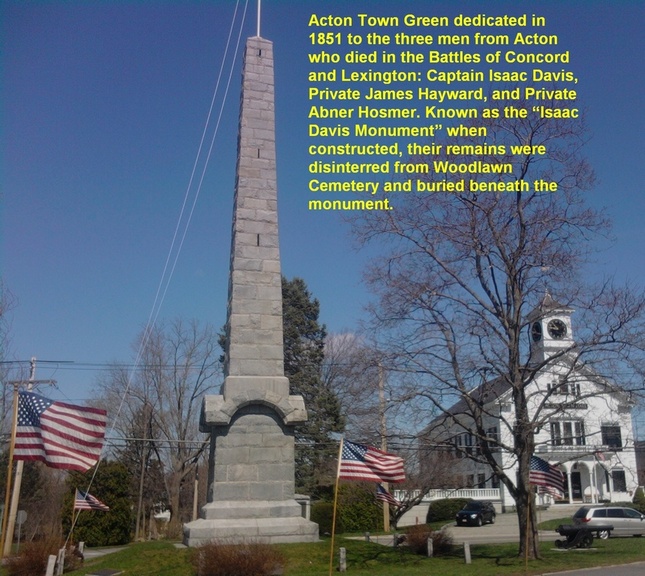
This powder horn was held up on the floor of the Massachusetts House of Representatives in 1851 by Rev. James Trask Woodbury, representative from Acton, as he delivered a highly emotional speech. He told the stories of the three men from Acton who had been killed in the Concord Fight and on Battle Road–Captain Isaac Davis, James Hayward, and Abner Hosmer–and beseeched the body to grant $2,000 for a large monument in Acton to be placed in their honor. On this occasion in 1851, Woodbury held up the powder horn and recalled the many conversations he had had with an elderly Benjamin Hayward, James’s brother, about James’s sacrifice and this object that they both held sacred:
…How often have I sat down, and with this very powder horn in my hand, that was, seventy-five years ago, smeared all over with the life-blood of a large-hearted, affectionate, brave brother…with equal streams coursing down my own face, have I fought, over and over again, with “Deacon Ben,” this battle…I should think it might do anybody good; for these tears are tears of gratitude—gratitude to these benefactors of our country and our race, and gratitude to God, who raised them up. Let them flow then, I say. Who would withhold them, if he could?
Many representatives wept right along with him, and Acton got its monument.
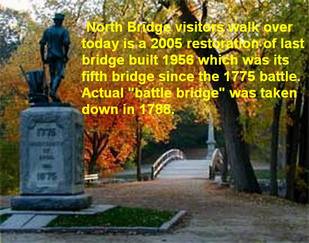
The same powder horn would be loaned in 1873 to young sculptor Daniel Chester French who had won himself the opportunity to create The Minuteman, a memorial which would be placed at the Old North Bridge, site of the Concord Fight. French (who would crown his career with the statue of Lincoln in the Lincoln Memorial) rode with his father from their home in Concord to Acton to get the powder horn from the Hayward family. Eager to make his Minuteman as authentic as possible, French sought out numerous artifacts from the Concord Fight. James Hayward’s powder horn hung on the wall of French’s studio for several weeks. A representation of it would be included in his finished statue.
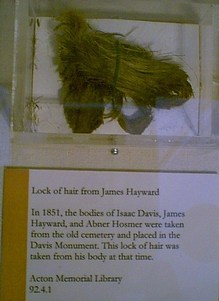
In 1851, the remains of Hayward, Davis and Hosmer were moved with great reverence and ceremony and re-interred under the 75 foot monument for which Woodbury and others had struggled. The exercises included an eloquent address by Governor George Boutwell. While the caskets were laid to rest, a band played a hymn, “Peace, Troubled Soul.”
Peace, troubled soul, thou need’st not fear;
Thy great Provider still is near;
Who fed thee last, will feed thee still:
Be calm, and sink into His will.
May all those who have sacrificed everything for our country rest in peace.
**********
Archaeological Resources
According to state law M.G.L. c. 9, § 27C, known as the “Antiquities Act,”143 archaeological sites must remain confidential as a way of protecting their fragile nature. As such, resources along the Battle Road Scenic Byway that may have archaeological intrinsic quality cannot be listed here. Many historic sites, such as house foundations and burial grounds, are listed under historic resources. These do not qualify as “archaeological” in the strictest sense, but they are “physical evidence of historic human life or activity,” as stated in the National Scenic Byways Program definition for archaeological quality.
GOD BLESS AMERICA!
Please review Following pictures for more details concerning My 2 Rocks Mentioned and the Historical locations they are from.